Articles
AII COMMITTEE OF SENIOR OFFICIALS – BRUSSELS, 9 OCTOBER 2024
The first AII Committee of Senior Officials (CSO) under Hellenic Chairmanship was held in Brussels on October 9, 2024.
Read more: AII COMMITTEE OF SENIOR OFFICIALS – BRUSSELS, 9 OCTOBER 2024
AII-PS Participates in MEDDIET Workshop in Ancona to Strengthen Adriatic-Ionian Cooperation - 16 October 2026

The Adriatic-Ionian Initiative Permanent Secretariat participated in the MEDDIET Working Group Meeting - Interactive Policy Workshop, entitled “Towards an EUSAIR Mediterranean Diet Innovation Network and Ecosystem”, held at the Marche Polytechnic University in Ancona on October 16th.
The event was jointly organised by the Marche Region and the Forum of the Adriatic and Ionian Chambers of Commerce (Forum AIC), in collaboration with Marche Polytechnic University and the Adriatic-Ionian Initiative PS, within the framework of the Italian Presidency.
The workshop brought together representatives of European and national institutions, regional authorities, universities, research centres, businesses and other stakeholders to explore opportunities for developing a macro-regional innovation network around the Mediterranean Diet.
The MEDDIET flagship initiative, developed through cooperation among EUSAIR Pillar 1 - Blue Sustainable Economy, Pillar 4 - Sustainable Tourism and Pillar 5 - Improved Social Cohesion, aims to promote the Mediterranean Diet as a shared cultural heritage and a driver of sustainable development, innovation and economic growth across the Adriatic-Ionian Region.
The Adriatic-Ionian Initiative was represented by Ambassador Giovanni Castellaneta and AII Executive Officer Filippo Alabardi, who addressed the institutional opening session.
In his remarks, Alabardi emphasised that the Mediterranean Diet represents much more than a nutritional model: it is a way of life, a cultural heritage and a shared element of identity connecting communities throughout the Mediterranean. He stressed that, despite its international recognition and well-established benefits, the Mediterranean Diet should not be taken for granted. Its preservation and promotion require continuous commitment, particularly in raising awareness among younger generations and ensuring that its traditions and values remain part of everyday life.
In this context, the Adriatic-Ionian Region, with its shared cultural roots, agricultural traditions and maritime heritage, offers a particularly favourable environment for strengthening cooperation. The MEDDIET initiative provides an opportunity to translate this common heritage into concrete actions supporting sustainable development, innovation and territorial cooperation.
The discussions also built on previous efforts to promote the Mediterranean Diet within the framework of Adriatic-Ionian cooperation, including the Šibenik and Split Declarations, highlighting the importance of regional dialogue and joint initiatives in preserving and valorising this shared cultural heritage.
Beyond the institutional opening, the workshop featured presentations of regional experiences and interactive World Café discussions focusing on three main areas: common vision and territorial strengths, smart specialisation and potential network nodes, and governance, knowledge and capacity building.
These exchanges contributed to identifying shared priorities, opportunities for cooperation and potential actions to support the development of the future EUSAIR Mediterranean Diet Innovation Network and Ecosystem. The outcomes will feed into the Ancona Recommendations, intended to guide the next steps of the MEDDIET flagship initiative.
The MEDDIET initiative represents a valuable opportunity to further strengthen cooperation across the Adriatic-Ionian Region, fostering connections between cultural heritage, sustainable food systems, research, tourism and innovation, while contributing to the broader objectives of EUSAIR and sustainable regional development.
For a detailed overview of the meeting, presentations and workshop outcomes, read the full event report published by Forum AIC.
AII Permanent Secretariat participates in NAVIMORE Kick-off Meeting - 8 September 2026, Ancona

On 8 September 2026, the Permanent Secretariat of the Adriatic-Ionian Initiative (AII-PS) participated in the Kick-off Meeting of NAVIMORE – “The Power of Data for Economic Enhancement”, a new project co-financed by the European Union under the Interreg Italy-Croatia 2021–2027 Programme, Third Call for Proposals.
The meeting officially marked the launch of the project activities and brought together project partners and associated partners to discuss NAVIMORE’s objectives, planned actions and next steps.
NAVIMORE focuses on the strategic use of data, digital tools and interoperability as drivers for economic development and stronger cross-border cooperation. By addressing data fragmentation and improving the capacity of institutions and relevant stakeholders to collect, share and use information more effectively, the project aims to contribute to more integrated and coordinated approaches across the two shores of the Adriatic.
A key element of the project will be the development of a Cross-Border Governance Model, designed to provide a shared framework for addressing common challenges and opportunities in the Italy-Croatia cooperation area and strengthening cooperation among institutions, territories and economic actors.
The AII Permanent Secretariat participates in NAVIMORE as an Associated Partner, bringing to the project its institutional experience and its network across the Adriatic-Ionian region. The Secretariat will contribute to promoting the project and its results among relevant institutions and stakeholders, supporting their dissemination and fostering links with the wider framework of regional and macro-regional cooperation.
Participation in NAVIMORE is consistent with the mission of the Adriatic-Ionian Initiative to promote dialogue, regional cooperation and closer connections among the countries and territories of the Adriatic-Ionian area. It also offers an opportunity to strengthen synergies between cross-border initiatives and broader cooperation processes in the Region.
Through improved interoperability, knowledge exchange and closer institutional cooperation, NAVIMORE seeks to develop solutions capable of supporting more connected, effective and sustainable cross-border governance, while creating results and experiences that can also be shared across the wider Adriatic-Ionian region.
The AII Permanent Secretariat looks forward to contributing to the implementation of NAVIMORE and to supporting the dissemination and capitalisation of its results within its institutional network.
NAVIMORE is co-financed by the European Union through the Interreg Italy-Croatia 2021–2027 Programme.
MEDDIET Working Group Meeting in Ancona on 16 October 2026
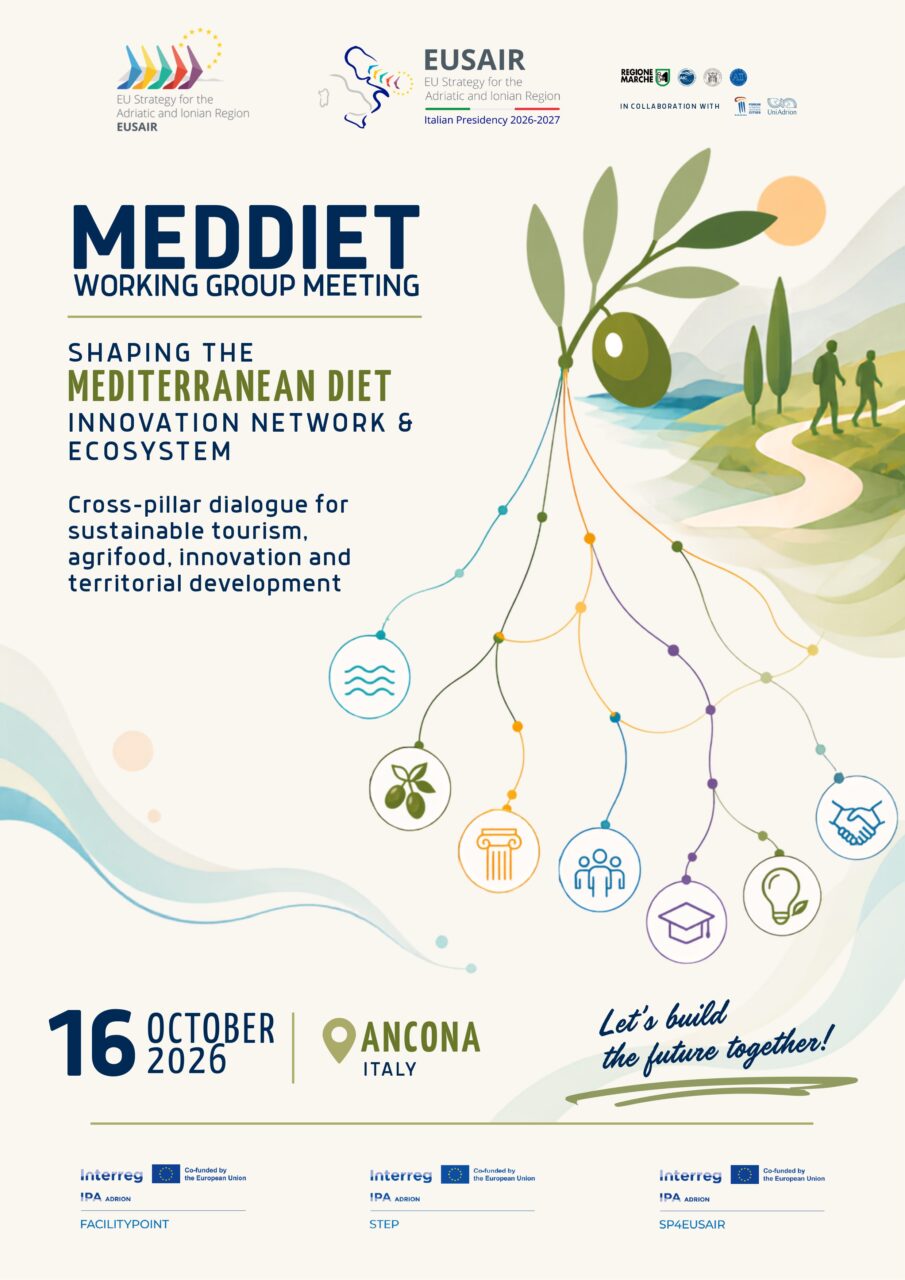
On 16 October 2026, Ancona will host the MEDDIET Working Group Meeting – “Exploring a Mediterranean Diet Innovation Network and Ecosystem: Cross-pillar dialogue for sustainable tourism, agrifood, innovation and territorial development”, at the Faculty of Economics of Marche Polytechnic University (UNIVPM).
The meeting will take place within the framework of the Italian Presidency of EUSAIR and of the cross-pillar cooperation among Pillar 1 – Blue Sustainable Economy, Pillar 4 – Sustainable Tourism and Pillar 5 – Improved Social Cohesion.
The event is hosted by the Marche Region and the Forum of the Adriatic and Ionian Chambers of Commerce (Forum AIC), in collaboration with Marche Polytechnic University (UNIVPM) and the Adriatic-Ionian Initiative Permanent Secretariat.
The meeting will bring together representatives of EUSAIR governance, national and regional authorities, universities, research organisations, Chambers of Commerce, businesses and civil society organisations from across the Adriatic-Ionian Region, with the aim of contributing to the further development of the MEDDIET Flagship.
Building on the work already carried out within EUSAIR, participants will exchange experiences and identify common priorities to strengthen cooperation between different sectors and levels of governance, exploring the contribution of the Mediterranean Diet to sustainable tourism, territorial development, innovation and skills development.
Particular attention will be devoted to the potential development of a Mediterranean Diet Innovation Network and Ecosystem, connecting universities, research organisations, Competence Centres, Living Labs, Biodistricts, Regional Agri-food Partnerships, Chambers of Commerce, businesses and public authorities in a common macro-regional framework. The objective is to foster stronger links between agrifood, tourism, research, innovation and territorial development across the Adriatic-Ionian Region.
Designed as an interactive Working Group rather than a traditional conference, the meeting will combine short inspirational contributions, participatory discussions and networking opportunities. The programme will also include a study visit showcasing regional good practices in research, innovation, sustainable food systems and territorial development.
Further information and the updated programme will be available soon.
AII at the 13th REDETE Conference – Ancona, 9–10 September 2026

The 13th REDETE Conference - Researching Economic Development and Entrepreneurship took place in Ancona on 9-10 September 2026, bringing together academics, researchers, policy-makers and practitioners to discuss the main economic and geopolitical challenges affecting the Adriatic-Ionian Region.
The Conference, organised by the University of Banja Luka and the Marche Polytechnic University, with the Adriatic and Ionian Initiative as a partner, focused this year on “Geopolitical Shifts, Supply Chains, and Regional Resilience in the Adriatic-Ionian Region”. As in previous editions, particular attention was devoted to the Adriatic-Ionian area and the Western Balkans, with European integration and enlargement featuring prominently throughout the programme.
The event took place in the framework of the 2026–2027 Italian AII/EUSAIR Chairmanship, which has placed the European integration of the Western Balkans among its main priorities.
On 9 September, Ambassador Giovanni Castellaneta, Secretary General of the Adriatic and Ionian Initiative, participated in the opening Plenary Session “Setting the Stage: Adriatic-Ionian Region and the Enlargement Scenario”, together with Prof. Laura Resmini of the University of Milano-Bicocca.
The session provided an important opportunity to discuss the political and economic implications of European integration and enlargement for the Adriatic-Ionian Region and, in particular, for the Western Balkans.
Addressing enlargement from a political perspective, Ambassador Castellaneta underlined that EU enlargement is today a strategic choice for the future of Europe, particularly in the current geopolitical context. He stressed the need for a common commitment to make the accession process more credible, concrete and effective, while ensuring that the Western Balkans remain fully at the centre of the European integration agenda.
He also highlighted the importance of gradual integration, allowing candidate countries to benefit from closer integration with the European Union even before accession through access to the Single Market, European programmes and other practical opportunities. Such measures, he stressed, must remain a bridge towards full EU membership and not an alternative to it.
Ambassador Castellaneta also recalled the strong commitment of the Italian Government to the European perspective of the Western Balkans, which continues to represent a key priority of Italy’s foreign policy and of the current Italian AII/EUSAIR Chairmanship.
Complementing the political perspective, Prof. Laura Resmini addressed enlargement and European integration from an economic point of view, focusing in particular on foreign direct investment, trade and the growing integration of the Western Balkan economies into European and global economic networks. Her contribution highlighted how stronger trade and investment links have contributed to increasing the resilience of the Western Balkans and their capacity to respond to external economic shocks.
The discussion confirmed the importance of combining the political and economic dimensions of enlargement. European integration is not only an institutional process, but also a means to strengthen economic ties, resilience and opportunities across the region.
In the broader framework of REDETE26, the REDETE Summer School “Regional Resilience, Innovation and Economic Transformation in the Adriatic–Ionian Region” was also launched in Ancona on 7 September. The Summer School, organised as an Erasmus+ Blended Intensive Programme, brought together around 60 students from five countries of the Adriatic-Ionian area for a week of lectures, seminars, workshops and direct participation in the REDETE Conference.
Filippo Alabardi, Executive Officer of the Adriatic and Ionian Initiative Permanent Secretariat, took part in the opening session with a contribution on “The Adriatic and Ionian Macro-Region as a Cooperation Platform”. He presented the origins and role of the Adriatic and Ionian Initiative and EUSAIR, highlighting their complementarity and the contribution of regional and macro-regional cooperation to the European integration process of the Western Balkans. Particular attention was devoted to the role of AII in promoting the establishment of EUSAIR and to the way in which the Strategy today enables EU Member States and candidate countries to work together on shared priorities and gradually strengthen their integration into the European framework.
For further information on the Conference and its programme, visit the official REDETE website: https://redete.org/